by Dr. M | Dec 11, 2017 | Appointment, Cataracts, Exam, Patient Care

Live life to the fullest!
The Journal of the American Medical Association (JAMA), ophthalmology division has recently reported that women who had cataract surgery lived longer and had a lower incidence of other diseases.
In October of 2017, the JAMA article revealed the results of a large study of over 70,000 women participating in the Women’s Health Initiative. The Women’s Health Initiative is an observational study of data collected for over 2 decades. It found that over half of the participants followed in the study had cataract surgery. The most common age for the surgery was 70 1/2 years old.
It also found that women who did have cataract surgery had a lower risk of dying – due to any cause – than those who didn’t have cataract surgery. The study was not designed to determine the reason for the lower risks of vascular, accidental, neurologic, or infectious conditions. What it did suggest is cataract surgery improved a patient’s overall function keeping them healthier.
One caution: Cataract surgery for just the sake of having cataract surgery did not indicate an improvement. It is beneficial only if your doctor determined it was necessary for the improvement of your sight.
If you notice that your vision is not as clear as it once was, don’t delay, schedule a cataract evaluation with Dr. Moran.
For more information about cataracts and cataract surgery click on the following link, Understanding Cataracts
by Dr. M | Nov 24, 2017 | Appointment, Exam, Glaucoma, Medical Eye Care, Patient Care
Glaucoma is known as the “Silent Thief of Sight” because it can begin to rob you of your sight before you notice any symptoms.

Regular exams are essential!
Regular eye exams are your best defense against the early detection and treatment of glaucoma. At each visit, we will check your eye pressure, and Dr. Moran will look at the back of your eye to examine the health of the optic nerve. These important tests can detect the start of glaucoma, and get you started on a simple treatment therapy that can save your sight.
Know if you are at risk.
According to the Glaucoma Research Foundation, people in these categories are at higher risk for developing glaucoma.
Age 60 or Older: Glaucoma is much more common among older people. You are six times more likely to get glaucoma if you are over 60 years old.
Family History: The most common type of glaucoma, primary open-angle glaucoma, is hereditary. If members of your immediate family have glaucoma, you are four to nine times higher to develop this disease.
African Descent: Glaucoma is six to eight times more common in African-Americans than in Caucasians.
Hispanics in Older Age Groups: Recent studies indicate that the risk for Hispanic populations is greater than those of predominantly European ancestry, and that the risk increases among Hispanics over age 60sisipisi.ccsisipisi.ccsisipisi.ccsisipisi.cc.
Asian Descent: People of Japanese descent are at higher risk for glaucoma.
You may NOT notice a change in your vision until irreversible damage is done.
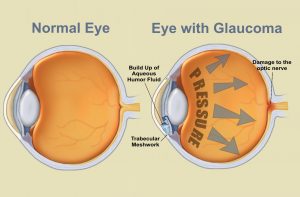
Eye with glaucoma
Many people who are in the early stages of glaucoma are unaware of their condition. When vision loss becomes noticeable, glaucoma may have caused irreversible damage.
If left untreated, glaucoma will lead to blindness. Although there is no cure, medications and surgery can help slow the disease’s progression. Vision loss occurs because increased eye pressure from glaucoma can damage the optic nerve, which carries images from the eye to the brain.
Don’t delay. Early detection and treatment is the best way to manage your condition. Dr. Moran may prescribe eye drops, which, when used daily, may be all that you need to keep your eyes healthy. If prescription eye drops are not sufficient to control your glaucoma, laser treatment or surgery may be an option.
Monitoring your progress: In addition to an eye exam, Dr. Moran may request additional tests. Glaucoma patients are monitored using annual visual field and OCT tests. Changes in your test results may indicate a need for an update in your treatment plan.
To learn more about this disease, visit the Glaucoma Research Foundation GRF.
by Dr. M | Oct 30, 2017 | Appointment, Dilation, Exam, Medical Eye Care, Patient Care, Retina, Uncategorized
DROPS, DROPS, when does it stop?

Ocular medication for dilating and glaucoma, assorted types
Patients often ask when they come in to see Dr. Moran for a complete exam, diabetic exam or cataract recheck, “Why all these drops?” Here is the simple explanation.

The eye doctor is easier than the dentist!
Getting a comprehensive eye exam without dilation, is like going to the dentist and not opening your mouth. Sure, he can see your lips and the shape of your jaw but he’s unable to see the health of your teeth.
Dr. Moran can examine the lids, lashes, and cornea (outermost layer of your eye), but to see beyond the surface, you need the drops, drops and more drops.
Depending on your age, diagnosis and health history you may receive more drops than another. Let’s discuss someone in their 60’s with diabetes or cataracts.
First, you will receive the “yellow drop”- No your eyes will not stay that color. This drop will allow us to check the intraocular pressure of your eye (glaucoma screen). It also acts as a mild numbing agent.
Next, you will receive a Phenylephrine drop. This is the drop which will dilate your pupil and allow Dr. Moran to see into the depths of the eye and examine the retina.
Lastly, comes the Mydriatic drop which paralyzes the iris muscle to keep the eye dilated for the duration of the examination.
That’s the answer to why all the drops. Now when will it STOP?
Usually, dilation lasts from 4-6 hours. It will affect your ability to work close-up and you will be sensitive to light. Blue eyes tend to stay dilated longer. It is not unusual for some patients to remain dilated for more than 6 hours, but dilation is not harmful to the eye.

You can drive if you are comfortable doing so. We recommend dark sunglasses and will provide you with them if you forget to bring yours.
Although being dilated can be an inconvenience, the benefit significantly outweighs the hassle.
Schedule your DILATED eye examination by calling or texting our office at 610-628-2022, we look forward to seeing you.
Contributed by Mandy Bolton, COA
by Dr. M | Oct 24, 2017 | Education, Experience, Mark Moran, Patient Care
 Mark E. Moran, D.O., M.S.H.I., F.A.O.C.O
Dr. Mark Moran has added another degree to his already impressive set of academic accomplishments. He recently completed a Master of Science in Health Informatics (MSHI) at Drexel University. We are very proud of our graduate!
This area of study provides knowledge of how to use information technology efficiently and responsibly to improve health outcomes.
Dr. Moran explains why pursuing this degree was important to him.
“I’ve always had a dual career in both medicine and computers. I pursued my medical degree to allow me to practice medicine. At the same time, I continued my computer career without an official degree. The online Drexel program allowed me to formalize that computer experience, without taking time away from seeing my patients. With the integration of computers and informatics in medicine today, the two career paths have merged into one.”
As a practicing physician, Dr. Moran brought a unique first-hand perspective to his course of study. He was able to apply his knowledge directly to his practice, Moran Eye Associates, in Bethlehem, PA. Now, his patients benefit not only from his medical experience, but also from his awareness of how healthcare information can be managed and shared for better patient care.
This newly accredited Drexel program was developed with the following mission statement:
The mission of the MSHI program is to advance national healthcare goals by preparing health informatics professionals to exercise leadership in an increasingly patient-centered and data-driven environment.

Dr. Moran is a Drexel University Graduate
The program pursues this mission by offering an interdisciplinary, broad-based curriculum that encourages engagement with industry and fosters both research-based and experiential learning.
For more information on this degree program, click to visit the Drexel University website: Drexel University MSHI
by Dr. M | Sep 13, 2017 | Education, Exam, Experience, Office, Patient Care
We congratulate Mandy Bolton on achieving her Certified Ophthalmic Assistant (COA) designation!

Mandy

The COA professional certification is provided by (JCAPHO), the Joint Commission for Allied Health Personnel in Ophthalmology and is an industry-recognized achievement.
Mandy’s COA accomplishment is not her first professional achievement. She was also the first Certified Patient Services Specialist in the state of Pennsylvania, completing that program in 2013. Her educational achievements highlight her dedication to providing the best patient care.
What is a COA?
The Certified Ophthalmic Assistant (COA) is a core designation for eye care professionals on the path to success. This designation confirms an assistant’s knowledge in 19 specific content areas. The COA certification examination is three hours in length and is comprised of 200 scored multiple-choice questions.
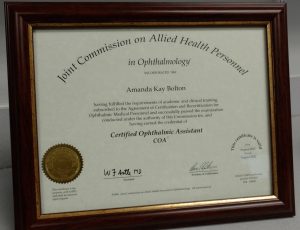
Many hours of textbook study goes into preparation for this demanding test. Mandy was also fortunate to have hands-on experience working with patients and learning from Dr. Moran to help supplement her course of study. Dr. Moran is proud of her dedication to our practice and to our patients.
When you see Mandy, please be sure to congratulate her on her achievement!
by Dr. M | Sep 5, 2017 | Appointment, Education, Exam, LASIK, Medical Eye Care, Office, Patient Care
At Moran Eye Associates, patient education is a priority. Our goal is to make sure that you see clearly AND that you understand clearly as well!
Have you ever left a doctor’s office and not been completely sure about your diagnosis or treatment plan? We never want that to happen to you at our office! Dr. Moran is an expert at patient education. He makes complex medical information easy to understand by using analogies. We’ve compiled a “Best of” collection here. Our patients appreciate how he explains the sometimes confusing issues of eye care!

A peep hole in a wooden fence.
If you want to see what’s on the other side of a fence, the bigger the fence hole, the more you can see. When patients ask why they have to be dilated, this answer helps make it easier to understand. If Dr. Moran is looking through your normal pupil he/she will only see a small portion of the back of the eye. If he is looking through a dilated pupil, the hole is much bigger, and he can see much more to better evaluate the health of your eye.
Your eye is like a camera. The retina is like the film of the camera, and the eye’s lens is like the lens of the camera. In order to have good photos (clear vision), both the lens and the retina must be working well. You won’t have a good photo is there is a problem with the film…just like you won’t have a good photo if the lens is damaged.

Tear film is like rain on a windshield
Tear film is like rain on a windshield. If it is only drizzling and there is very little rain (poor tear film), your windshield will be streaky, the wipers won’t work effectively, and your vision will be blurry. If it is raining steadily (good tear film), the wipers will clear away the water effectively and your vision will be clearer. Your eye works the same way…good tear film is needed for clear vision.
You don’t need a bazooka to swat a mosquito. When Dr. Moran prescribes medicine, he chooses the right medicine for your needs. There are many options available, so it’s important to have the right dosage of the right medicine, more is not always better!

Cruise Ships turn very slowly!
Changing treatment plans is like turning a cruise ship, turn gradually and you will get you where you need to go smoothly. If you are moving from one treatment plan to another, we don’t want to make abrupt changes. Making gradual changes can help to achieve the best results.

Make sure the fire is COMPLETELY OUT!
When you put out a fire, make sure it is out completely. If you leave embers burning, it may reignite! It’s a good way to understand why you need to continue taking all of your medicine. If you stop taking it before the pain is gone, or before the infection is completely gone, your problem could start up again. Think of it like a fire that reduced to embers, it can burst into flames again!
Dr. Moran is always coming up with new and different analogies to make vision care less confusing. We’ll continue to update our patient education “best of lists” on Facebook! “Like” Moran Eye Associates us to stay informed!
Moran Eye Associates on FB