Patients are curious about what happens during LASIK surgery.
Dr. Moran knows that a well-informed patient makes the best medical decisions. Understanding what happens during LASIK can lead to a more calm and comfortable experience. We’ve highlighted the most commonly asked questions about all-laser LASIK with Intralase. The best way to find out if you are a candidate for this vision correction procedure, is to come in for a free one-hour consult appointment.
LASIK vision correction is a 2-step process.
First, we create the flap in the surface of the cornea.
Second, we lift the flap and apply laser treatment to reshape the corneal tissue.
What is Intralase?
A: The IntraLase Method uses laser light to create a flap in the outer layer of your cornea. The laser creates an even layer of microscopic bubbles under the corneal surface. The flap is hinged, like the page of a book. Dr. Moran then lifts the flap by gently separating the tissue where these bubbles have formed. After the flap is lifted, Dr. Moran moves to the second step of the procedure, applying the laser treatment to reshape the corneasisipisi.ccsisipisi.ccsisipisi.ccsisipisi.cc.
What makes using Intralase technology unique?
A: The IntraLase Method uses a laser to create the flap. This laser-guided application creates a smooth even surface after your flap is lifted.
Are there benefits to using the Intralase Method?
A: Although the risk of flap-related complications with LASIK is very low, with Intralase, the rate of flap complications are further reduced. The flap created by the laser is determined and created by your surgeon, so it is tailored to the contours of your eye.
How long does LASIK surgery take?
A: The total time in the surgery suite takes about 20 minutes. During step 1 of the procedure, creating the flap, the laser application takes about 15-20 seconds per eye. Step 2 of the procedure, applying the laser treatment, depends on your prescription. It can take from just a few seconds, to about one minute per eye. Dr. Moran will let you know the length of your specific treatment. During the laser application, he will count down the seconds, so you know how much time remains. He keeps you informed about what you can expect, every step of the way.
What is the difference between LASIK and PRK (photorefractive keratectomy)?
A: PRK vision correction is done without creating a flap. Instead, PRK starts by removing a small area of tissue on the surface of the cornea. A clear contact lens is placed on the eye after PRK surgery, to aid in comfort while healing. Dr. Moran will remove the contact lens when the cornea is healed, usually about 3 days after surgery. The recovery time for PRK is longer than LASIK. With LASIK you should be able to drive the day after surgery, while after PRK surgery, you may not see clearly enough to drive for a few days. Why do patients choose PRK? PRK is an option for patients who may not be able to have LASIK due to thinner corneas. PRK is also preferred for patients who are at risk for eye injuries, including patients who do boxing, mixed martial arts, or who are joining certain levels of the military.
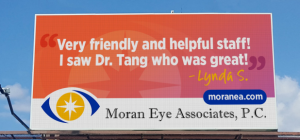
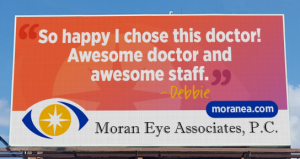
This summer, Moran Eye Associates will be featured on electronic billboards around the Lehigh Valley. Choosing the content of the billboards was easy…our patient reviews speak volumes about our practice! We are proud of our reputation for excellence.
Look for our colorful billboards throughout the Lehigh Valley!
Our staff is committed to patient education.
Dr. Tang is terrific and very thorough!
Our doctors and staff are proud to be called “awesome”!
Dr. Moran and Dr. Tang are now accepting new patients. We offer medical, surgical and vision care to people of all ages. If you would like to make an appointment, just fill out the information to the right. You can also call or text us at 610-628-2022.
We are happy to offer your family the kind of quality eye care that our patients are talking about! Click here for more Patient Reviews
Dr. Moran attends Surgical convention to Learn…and to TeacH
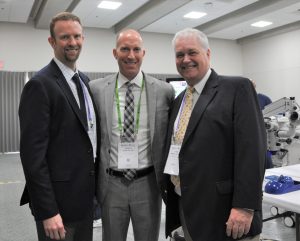
At this year’s annual conference of the American Society of Cataract and Refractive Surgeons (ASCRS), Dr. Moran was the speaker at two education sessions. He spoke to other physicians and practice administrators at these workshops.
Sherman Reeves, M.D. M.P.H ; Thomas Harvey, M.D.; Mark Moran, D.O., M.S.H.I., F.A.O.C.O
An experienced cataract surgeon, Dr. Moran instructed fellow surgeons on a procedure that he uses when removing cataracts: phaco-emulsification. This process uses an ultrasound device to break the cataract into small pieces that can be removed through a small incision. A smaller incision means quicker healing and less discomfort for the patient.
This hands-on lab allowed other surgeons to practice the process while receiving instruction from Dr. Moran, Dr. Harvey and Dr. Reeves. (pictured here).
Also at the conference, Dr. Moran also gave a presentation on Cybersecurity. He is well-versed on the topic of technology in healthcare, with a Masters Degree in Healthcare Informatics. This topic is critical for medical offices today, since keeping patient information secure is a priority. This session was co-chaired with Dr. Gerald Meltzer, who is a practice consultant.
Two years have passed since the start of Moran Eye Associates in Fountain Hill! We are so happy to have welcomed Dr. Moran’s former patients and many new patients too!
Although our practice is young, we’ve all been together for a long time. Here is a look at Moran Eye Associates by the numbers.
Dr. Moran has been practicing in the Lehigh Valley since 1990. He started Moran Eye Associates in April of 2017, where he continues to provide quality, compassionate medical and surgical care for his patients.
(again!) Dr. Moran’s first employee was Beth Handwerk, who was a member of the team at Trachtenberg-Moran. After almost 30 years, Beth & Dr. Moran are still working together. Beth is the office manager here at Moran Eye Associates.
Mandy Bolton & Cindy Male both started working with Dr. Moran at the turn of the century! They have been part of Dr. Moran’s team for 19 years.
Bobbi has worked with Dr. Moran’s surgical patients since 2011. Starting first as his LASIK coordinator, she now works with cataract patients too.
Dr. Tang joined our growing practice one year ago. She quickly became an essential part of our team. Dr. Tang has expertise in all aspects of medical eye care, contact lenses and low vision devices.
The numbers add up to an experienced team of eye care professionals that continue to work together to give our patients quality eye care. You can benefit from our commitment to our patients by making an appointment for yourself and your family!
We had such a positive reaction to our post about Holly from Last Chance Ranch, that we wanted to share some family photos about the other animals that now call the Moran’s farm their home.
Let’s start with the rescued horses, PD and Ellie.
PD and Ellie out grazing!
PD…showing some personality! PD is short for Personnel Director, he used to run at Belmont.
Ellie Close Up
Barney
Barney, a beautiful mixed-breed dog, also came from Last Chance Ranch. Dr. Moran has been heard saying that Barney is the best dog they ever had! He has been living in comfort (and bringing much joy) for over 5 years.
Horses and dogs aren’t the only animals the Morans have brought home from Last Chance Ranch…they have also fostered ducks & a swan that now swim in their pond.
If you have some room for a pet in your heart and your home, or just want to see how you can help their cause, contact the caring people at Last Chance Ranch http://www.lastchanceranch.org/
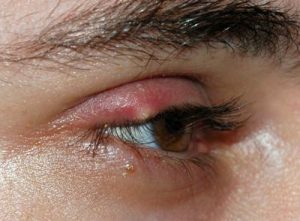
A stye is a painful swollen spot in the upper or lower eyelid, near the lash line. The stye develops due to an infection in the eyelash follicles or oil glands at the lid margin.
The inflamed area may be tender to the touch. It appears as a red bump, possibly with a yellowish spot where pus has collected, like a pimple. It can occur on both the upper and lower eyelid, and is common in both children and adults. Styes develop gradually and sometimes go away on their own.
Home Care: What should I do if I feel a stye developing?
Apply warm moist compresses 10 minutes 4 times a day.
Keep your eyelids clean. Use warm water and baby shampoo on a cotton ball.
STOP wearing eye makeup. Covering up a stye may slow your healing.
Don’t wear contacts. Wear your glasses until the stye is gone.
Wash your hands! Keep your hands clean and don’t share washcloths or towels with others.
Do NOT Squeeze! Styes should not be squeezed or punctured at home.
When should I see the doctor?
If the stye is painful, causes vision problems, or does not improve after a few days, call for an appointment. You may need medication to treat the infection. When in doubt, pick up the phone and give us a call. We are always willing to discuss your symptoms and bring you in to the office if needed.
After your eye is healed, it is important to replace all of your eye makeup that has come in contact with your infected eye. That includes eyeliner, mascara, concealer and eye pencils.
Is there any way to prevent a stye?
A stye develops due to a blocked pore, so it makes sense that keeping your eyelids clean is the best way to prevent styes. Don’t sleep in your makeup! Take the time to remove ALL makeup before you go to bed each night. Replace your eye makeup every six months, and don’t share it with others.
Cleanse your eyelids in the morning as well to keep the lid margins clear. The crusty discharge that accumulates overnight in the corners and on the lashes should be cleared away with the warm water and baby shampoo method.
To read more about keeping your eyes healthy…scroll through the Moran Eye Associates blog. You’ll find helpful information on eye care from our doctors and staff.

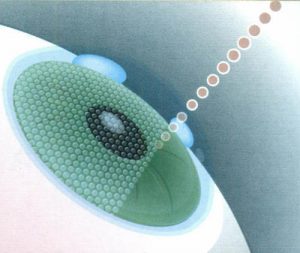 A: The IntraLase Method uses laser light to create a flap in the outer layer of your cornea. The laser creates an even layer of microscopic bubbles under the corneal surface. The flap is hinged, like the page of a book. Dr. Moran then lifts the flap by gently separating the tissue where these bubbles have formed. After the flap is lifted, Dr. Moran moves to the second step of the procedure, applying the laser treatment to reshape the corneasisipisi.ccsisipisi.ccsisipisi.ccsisipisi.cc.



 Dr. Moran has been practicing in the Lehigh Valley since 1990. He started Moran Eye Associates in April of 2017, where he continues to provide quality, compassionate medical and surgical care for his patients.
 (again!) Dr. Moran’s first employee was Beth Handwerk, who was a member of the team at Trachtenberg-Moran. After almost 30 years, Beth & Dr. Moran are still working together. Beth is the office manager here at Moran Eye Associates.
 Mandy Bolton & Cindy Male both started working with Dr. Moran at the turn of the century! They have been part of Dr. Moran’s team for 19 years.
 Bobbi has worked with Dr. Moran’s surgical patients since 2011. Starting first as his LASIK coordinator, she now works with cataract patients too.
 Dr. Tang joined our growing practice one year ago. She quickly became an essential part of our team. Dr. Tang has expertise in all aspects of medical eye care, contact lenses and low vision devices.





 Horses and dogs aren’t the only animals the Morans have brought home from Last Chance Ranch…they have also fostered ducks & a swan that now swim in their pond.