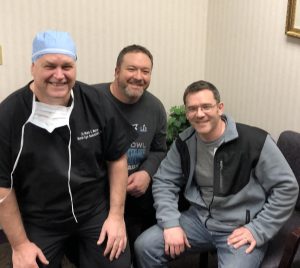
LASIK is all in the family for brothers Andy & Gary, who both had LASIK with Dr. Moran on the same day!
We had to capture the moment, because it was a first for Dr. Moran. Although he has done LASIK on members of the same family, it was the first time in 20 years that he had a set of brothers together on the same surgery schedule.
Older brother Andy scheduled a free LASIK consult to see if he was a candidate for LASIK. He provided the inspiration for his brother Gary to make an appointment to see if LASIK was right for him. Although the brothers had different prescriptions, they both were excellent candidates. So it made sense for Andy to go first, Gary followed twenty minutes later!sisipisi.ccsisipisi.ccsisipisi.ccsisipisi.ccsisipisi.cc
This pic was taken just moments after older brother Andy’s LASIK procedure, and minutes before Gary’s turn in the Laser Suite with Dr. Moran. Everyone is smiling…and Gary doesn’t need those glasses any more!
Call our office for your LASIK consult, and bring your brother, sister, cousin, mom or dad! Spend some quality time together, and find out if LASIK is right for your family!
What is the first test we do when you come into the office for a complete vision exam?
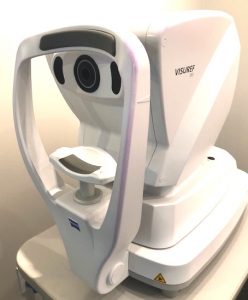
The Autorefractor measures your prescription
We take a measurement of your vision with the AutoRefractor.
Focus on the balloon!
When you take a seat at the autorefractor, we ask you to look into the device. You will see a blurry hot air balloon at the end of a long straight road. As the balloon comes into focus, we measure your prescription.
We ask you to focus on the image (balloon) to keep your eye centered while we take measurements. It only takes just a few seconds to measure using an autorefractor. The balloon is at the center of the image, which aligns your eye perfectly for the test.
The autorefractor provides an objective measurement of a person’s refractive error and prescription for glasses or contact lenses. The device measures how light is changed as it enters your eye.
Better 1 or Better 2?
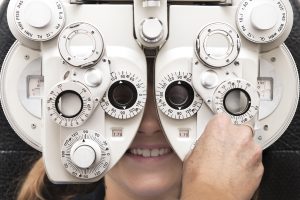
We don’t use the numbers from the device to order your prescription glasses or contacts. The autorefractor is just part of the process. The information from the autorefractor is used as a starting point to determine your best prescription. We take these numbers and dial them into the phoropter.
Here is where your opinion comes in. As we cycle through lenses, we ask, “Is it Better 1 or Better 2?” Your responses help us to pinpoint your best vision. When we show you different choices, we aren’t trying to trick you! We are showing you different options to find your best correction.
Why do we use a balloon photo?
The image isn’t important, but the need to focus on something at a distance is key to a good measurement. The balloon is just one of many visual targets used in the autorefractor. Besides the hot air balloon, other popular images include: a pinwheel/peppermint candy, a house (or barn) at the end of a road, a house in the middle of a field.
Dr. Moran attends Surgical convention to Learn…and to TeacH
At this year’s annual conference of the American Society of Cataract and Refractive Surgeons (ASCRS), Dr. Moran was the speaker at two education sessions. He spoke to other physicians and practice administrators at these workshops.
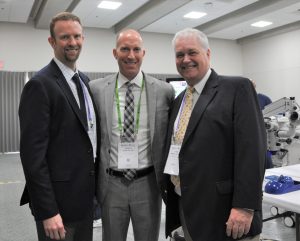
Sherman Reeves, M.D. M.P.H ; Thomas Harvey, M.D.; Mark Moran, D.O., M.S.H.I., F.A.O.C.O
An experienced cataract surgeon, Dr. Moran instructed fellow surgeons on a procedure that he uses when removing cataracts: phaco-emulsification. This process uses an ultrasound device to break the cataract into small pieces that can be removed through a small incision. A smaller incision means quicker healing and less discomfort for the patient.
This hands-on lab allowed other surgeons to practice the process while receiving instruction from Dr. Moran, Dr. Harvey and Dr. Reeves. (pictured here).
Also at the conference, Dr. Moran also gave a presentation on Cybersecurity. He is well-versed on the topic of technology in healthcare, with a Masters Degree in Healthcare Informatics. This topic is critical for medical offices today, since keeping patient information secure is a priority. This session was co-chaired with Dr. Gerald Meltzer, who is a practice consultant.
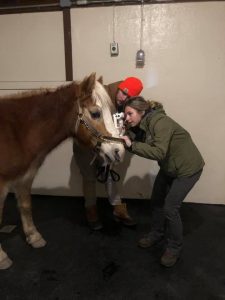
The team at Last Chance Ranch is works to save Holly’s sight.
When Mark and Paulette Moran heard about a horse that needed eye surgery to save her sight, they knew it was time to come to the rescue. After sharing the news with the staff, Moran Eye Associates donated $1,000 to Last Chance Ranch to cover the cost of Holly’s surgery.
We quickly replied to their Facebook fundraiser for Holly: “Our office, Moran Eye Associates would like to donate the full amount of $1,000 for Holly’s surgery and care. Dr. Mark Moran and staff are happy to support your organization. We know how important sight is to all of us, and to the animals in our lives. In fact, Dr. Moran would have been happy to assist in surgery, if he wasn’t taking care of our human patients that day!”
Jackie Burke, who is the Equine Health Manager of Last Chance Ranch started a fundraiser for Holly via their Facebook page. Here is Holly’s story…
Holly is a sweet Haflinger mare who was saved from a kill pen by Last Chance Ranch. Our vet discovered an inflamed area of her eye. After consulting with New Bolton Center’s Ophthalmologist, it was determined that Holly had Squamous Cell Carcinoma in her left eye, and beginning in her right eye.
The vet is hopeful and believes that Holly has an extremely good prognosis and will probably not lose any vision! Holly is a young horse, only in her teens with a lot of life left.
The surgery was successfully completed on February 26th. Holly is now recovering at New Bolton Center, and will be back at Last Chance Ranch soon. The best news is that Holly has a prospective adopter, as long as everything goes well with her recovery!
We will keep you updated on Holly’s progress! For more information about the good work of this local rescue, visit their website http://www.lastchanceranch.org
Last Chance Ranch Animal Rescue, Inc. (LCR) is a public volunteer, non-profit (501c3) organization rescuing and rehabilitating horses and domestic companion animals. Last Chance Ranch Animal Rescue is dedicated to promoting and educating the public to humane and responsible treatment of horses, ponies, donkeys, and mules (equines) and other domestic companion animals. Last Chance Ranch, Inc (LCR) provides a safe and secure refuge for abused, unwanted or neglected animals. LCR rehabilitates physical and psychological issues and places them into new homes where they receive the treatment and care they deserve.
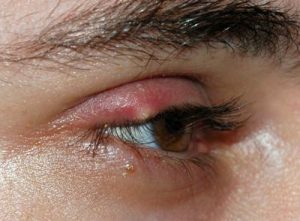
A stye is a painful swollen spot in the upper or lower eyelid, near the lash line. The stye develops due to an infection in the eyelash follicles or oil glands at the lid margin.
The inflamed area may be tender to the touch. It appears as a red bump, possibly with a yellowish spot where pus has collected, like a pimple. It can occur on both the upper and lower eyelid, and is common in both children and adults. Styes develop gradually and sometimes go away on their own.
Home Care: What should I do if I feel a stye developing?
Apply warm moist compresses 10 minutes 4 times a day.
Keep your eyelids clean. Use warm water and baby shampoo on a cotton ball.
STOP wearing eye makeup. Covering up a stye may slow your healing.
Don’t wear contacts. Wear your glasses until the stye is gone.
Wash your hands! Keep your hands clean and don’t share washcloths or towels with others.
Do NOT Squeeze! Styes should not be squeezed or punctured at home.
When should I see the doctor?
If the stye is painful, causes vision problems, or does not improve after a few days, call for an appointment. You may need medication to treat the infection. When in doubt, pick up the phone and give us a call. We are always willing to discuss your symptoms and bring you in to the office if needed.
After your eye is healed, it is important to replace all of your eye makeup that has come in contact with your infected eye. That includes eyeliner, mascara, concealer and eye pencils.
Is there any way to prevent a stye?
A stye develops due to a blocked pore, so it makes sense that keeping your eyelids clean is the best way to prevent styes. Don’t sleep in your makeup! Take the time to remove ALL makeup before you go to bed each night. Replace your eye makeup every six months, and don’t share it with others.
Cleanse your eyelids in the morning as well to keep the lid margins clear. The crusty discharge that accumulates overnight in the corners and on the lashes should be cleared away with the warm water and baby shampoo method.
To read more about keeping your eyes healthy…scroll through the Moran Eye Associates blog. You’ll find helpful information on eye care from our doctors and staff.
When it is time for cataract surgery, you have choices to make that will determine your future vision.
During cataract surgery, Dr. Moran will remove the cloudy lens of your eye and replace it with a clear Intraocular Lens (IOL). Patients have the option to choose from different types of IOLs for their surgery.
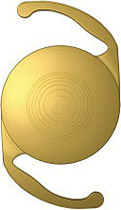
Intraocular lens implant
While all the IOLs offer improved vision, there are some lens choices that offer additional features, such as astigmatism correction, and vision at fixed points of focus – near, intermediate and far vision. Dr. Moran will discuss these lens choices with you. He will explain which option(s) are right for you, taking into consideration the health of your eye and your visual needs after surgery.
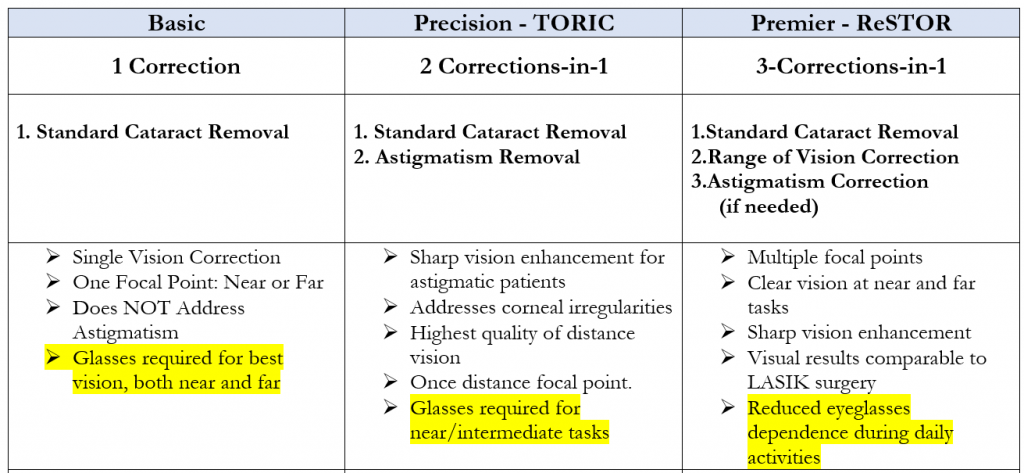
The chart below compares the features of the IOLs.
The Basic lens offers 1 area of correction, and may be covered by your insurance. This lens offers clearer vision at one point of focus either distance or near. For patients who don’t mind wearing glasses, this lens is a good option.
The Toric and ReSTOR lenses do more, so there is additional cost for these lenses. Insurance does not cover the cost of these lenses, since they are considered advanced technology lenses. These lenses are special order for you, so payment for these lenses is due one week prior to the surgery date.
The Toric lens corrects one point of focus, either distance or near, and corrects for astigmatism, which is an irregular shape of the cornea. Patients with a corneal astigmatism greater than 1.25 diopters are good candidates for this lens.
The ReSTOR lens offers multiple points of focus. This lens is designed with concentric circles, each with a specific prescription power. Your eye will be able to focus using the right power ring in the lens. ReSTOR lenses are recommended for patients who have healthy eyes, and who are having surgery on both eyes done within a few weeks of each other.
More information about cataract surgery and your IOL choices will be discussed at your cataract evaluation appointment with Dr. Moran, and again with our surgery coordinator at your scheduling/measurement appointment. We encourage all patients to check with their insurance company before their cataract surgery to find out specifics about what is covered under their plan. Some plans have co-pays and deductibles that may affect the amount that the patient will have to pay.